
ROB RUN Wiki: Systems, Weapons, Maps & Progression
A systems-first ROB RUN wiki for Early Access: crime and death rules, the power pyramid, weapons data, maps, bases, clans and the weekly wipe.
Quick answer. This ROB RUN wiki covers the rules that decide whether a run succeeds: who loses what on death, how the five-tier power pyramid pays out, how the seven-day wipe resets the board, and which weapons and cargo are worth the bag space. Every page is dated for the Early Access build.
- Official mechanics are separated from community-tracked data.
- Numbers are labelled with their source and checked date.
- The hub is organised by decision, not by item name.
The four rule sets that explain ROB RUN
Most questions about the game reduce to one of four systems. Learn these and the rest of the wiki becomes navigation.
| System | Question it answers | Where it is covered |
|---|---|---|
| Role and death | What do I lose when I die? | Beginner guide |
| Property | Who owns the ground and who taxes it? | Power pyramid |
| Reset | What survives the seven-day wipe? | Wipe |
| Risk | Why is the city more dangerous the longer I stay? | Notoriety |
The first is official and unambiguous. The second is official in structure but has gaps in the published numbers. The third is official, with a caveat that the cycle length may change. The fourth is partly community-observed; treat it as a model, not a manual.
What is confirmed by Kefir
These points come from the official Steam page and the ROB RUN Help Center, and are safe to plan around:
- The game is free to play and in Early Access, launched 4 November 2026.
- Looty Bay is the main city; the desert and the prison are separate spaces with different death rules.
- Criminals lose their inventory on death in Looty Bay; surrender keeps equipped gear.
- Civilians in the city keep bag and gear; police lose only department-issued gear.
- The Federal Raid runs every seven days and wipes plots, bases, weapons and cash into jail time and authority.
- Cosmetics, player name, tutorial progress, settings and accumulated jail time survive.
- A clan holds up to 100 players and can be switched during a cycle.
- The Power Pyramid has five tiers, from Hobo to Shadow Governor.
- B-Coins buy cosmetics only and do not affect stats or progression.
What is community-tracked
The following data is useful but not published by Kefir in a patch note or help article. It is tracked by players, including this site, and can change without warning:
- Weapon damage and RPM values, including Mark 1 to Mark 3 variants.
- Cargo base values and fence price ranges.
- Vehicle top speeds.
- The practical effect of notoriety on loot quality and police attention.
The weapons list→ and loot value table→ both carry a checked date and a note explaining the source. If the game disagrees with a table, the game is right.
Early Access balance patches can invalidate a number overnight. The launch build already changed cop respawn timing, police badge availability and starting weapons. Re-check any value that decides a purchase.
How the map fits together
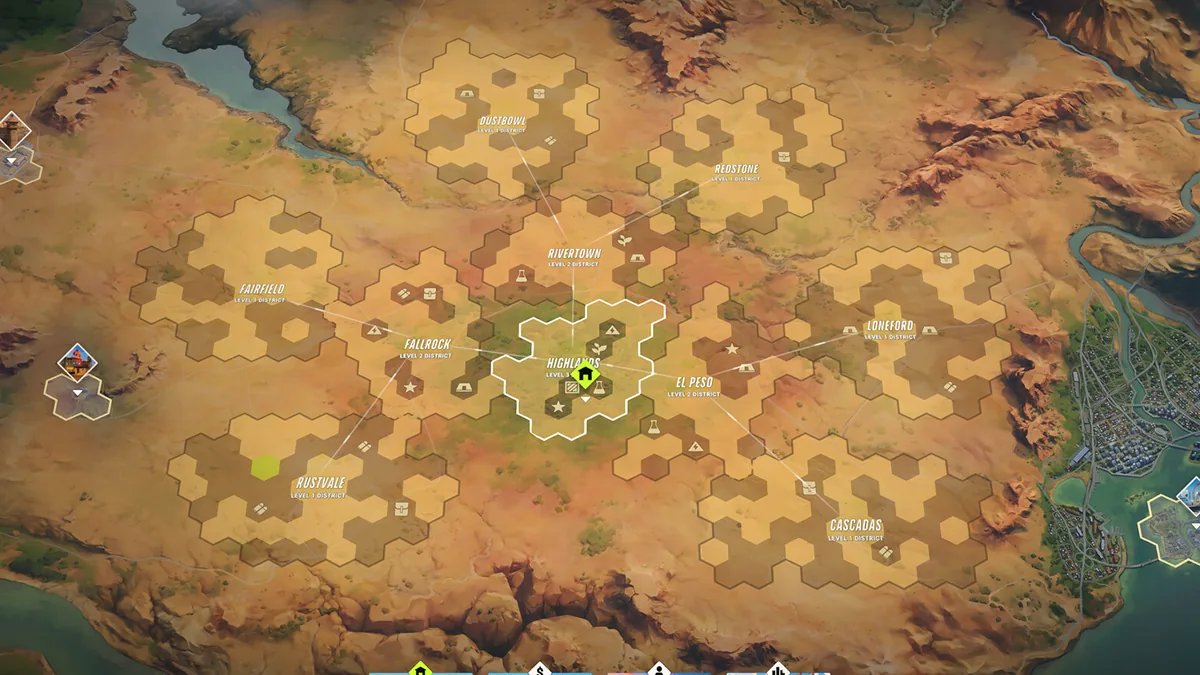
The global map is shared by all players on a server. It is divided into districts, and each district contains settlements. A settlement must have an owner before plots inside it can be rented. District level controls what can be bought there, and level 2 and level 3 plots require special documents from the Black Market.
That chain matters because it explains why "find a quiet spot and build" is not a strategy. Quiet land is quiet because nobody owns it, and nobody owns it because it is not worth owning yet. The map guide→ walks through the chain; the locations page→ lists the loot spots.
How progression actually works
There is no character level in the usual RPG sense. Progression is a property ladder:
- Hobo — no cash, no home, sleeping at Lenny's Motel.
- Settlement Resident — rents a plot and a base.
- Settlement Owner — buys a settlement and collects a cut from tenants.
- District Owner — controls a district through a clan and takes a cut of settlement taxes.
- Shadow Governor — the top of the pyramid, with the best laundering terms and tax income.
Each tier takes a cut from the one below. The power pyramid page→ explains the money flow and what is still unpublished.
Where to start
If you only read one page, read the beginner guide→. If you are already making money, read the money guide→ and the bank page→. If you are planning a group, read clans→ and wipe→ together.
FAQ
Is this an official ROB RUN wiki?
No. It is an independent guide site. Official rules are linked to Kefir's Help Center and Steam page; community-tracked data is labelled as such.
How often is the wiki updated?
Pages are dated and checked against the live build. The Early Access launch window is changing quickly, so treat any page older than a patch as a baseline rather than a guarantee.
Does ROB RUN have a skill tree?
Not in the current published build. Progression comes from gear, base facilities, clan position and the Power Pyramid, not from allocating skill points.
What is the best page for a returning player?
Read the wipe page→ first. If the cycle length or reset rules changed, every other plan changes with them.
Official source: Kefir Help Center, ROB RUN Steam store page and Steam announcements (checked 2026-11-06).
Sources
- Kefir Help Center — ROB RUN ↗ — official rules for death, wipe, property and police.
- ROB RUN Steam store page ↗ — feature list and Early Access status.
- ROB RUN Steam announcements ↗ — patch notes and launch changes.
- Official ROB RUN Discord ↗ — community reports and developer replies.